The test
The idea comes from Gemini 4 Argon vs Claude Opus 5.5 on OhMyUnicorn, which gave cloud models a request to build a planet. The same request went to my first two local models, word for word, typos included. I gave the third local model the same request, also word for word:
output a ThreeJS 3D cartoony/comics-like planet, with vibrant life on it: clouds, mountains, city buildings, cars and plane romaing it. It should be possible to orbit around and zoom and see the details. No harness is to be used
There’s one big difference. The cloud runs also received 223 KB of project notes, which aren’t published, and a line asking for a single index.html. My runs — all three of them — got only the sentence above, in an empty folder.
I sent one prompt and didn’t step in while it worked. It used its tools to write code, run it, and open its page in a headless browser to check its work.
My setup
| Inkling 2 Mini run | |
|---|---|
| Date | 24 November 2026 |
| Model | Inkling 2 Mini, local (vLLM-redshift) |
| Server | vLLM-redshift (vLLM patched for the R9700), image ghcr.io/abhinand5/vllm-redshift:inkling2-mini-v0.5.1; served on 127.0.0.1:8005 behind the 8096 shim |
| Hardware | AMD Radeon AI PRO R9700 (32 GB), Intel i7-13700K, 62 GiB RAM, 16 GB swap |
| Serving | Full GPU mode (whole card), 196k context, 2 requests at once, FP8 KV cache, DSpark speculative decoding (7 draft tokens) |
| Agent | Pi with thinking on, up to 32,768 tokens a reply, compacting its history |
| Agent tools | Bash and codemode (headless Chromium via Playwright MCP), plus read, write and one fetch |
This is the same machine the two Qwen3.8 runs used, but a different serving stack: Strata for the Qwen runs (0.2.9 and 0.2.10) and vLLM-redshift for this one. They’re not a fair race — see the note in What this doesn’t show.
Results
These numbers come from Pi’s session log, from the prompt until the model first said it was done.
| Inkling 2 Mini | |
|---|---|
| Total time | 25.7 min |
| Waiting for the model | 24.9 min |
| Running tools | 0.8 min |
| Model turns | 166 |
| Tool calls | 165 |
| Edits to the code | ~36 |
| Output tokens | 168k |
| Output speed, whole run | about 110 tok/s |
| Input tokens, cumulative (incl. full-context resends) | ~13.4M |
| Reasoning tokens | ~91k |
| Times it compacted its history | 1 |
| Screenshots it saved of its own work | 37 |
| Final page | 5 files, ~676 KB, main.js 1,061 lines |
| Console errors when I opened it | 0 |
The planet
Play it yourself: Inkling 2 Mini planet. Like the two Qwen planets, it loads Three.js from a plain <script> tag and is served exactly as the model left it — a small standalone folder, not one self-contained file.
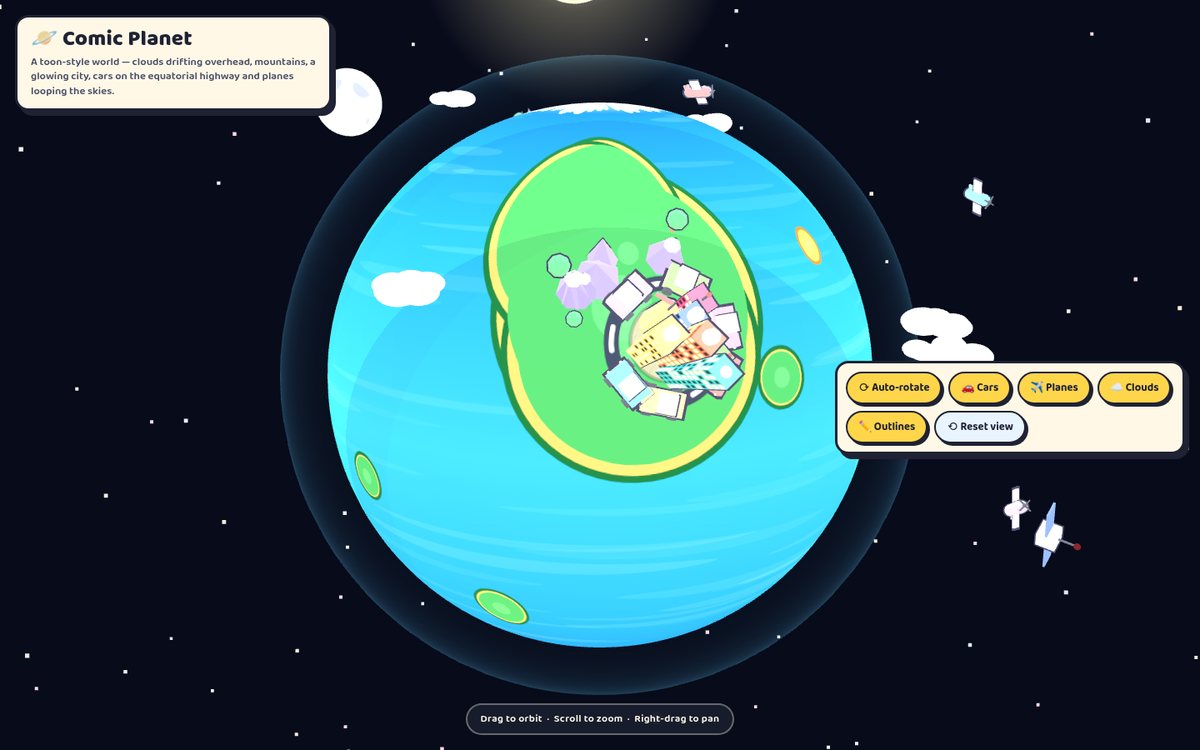
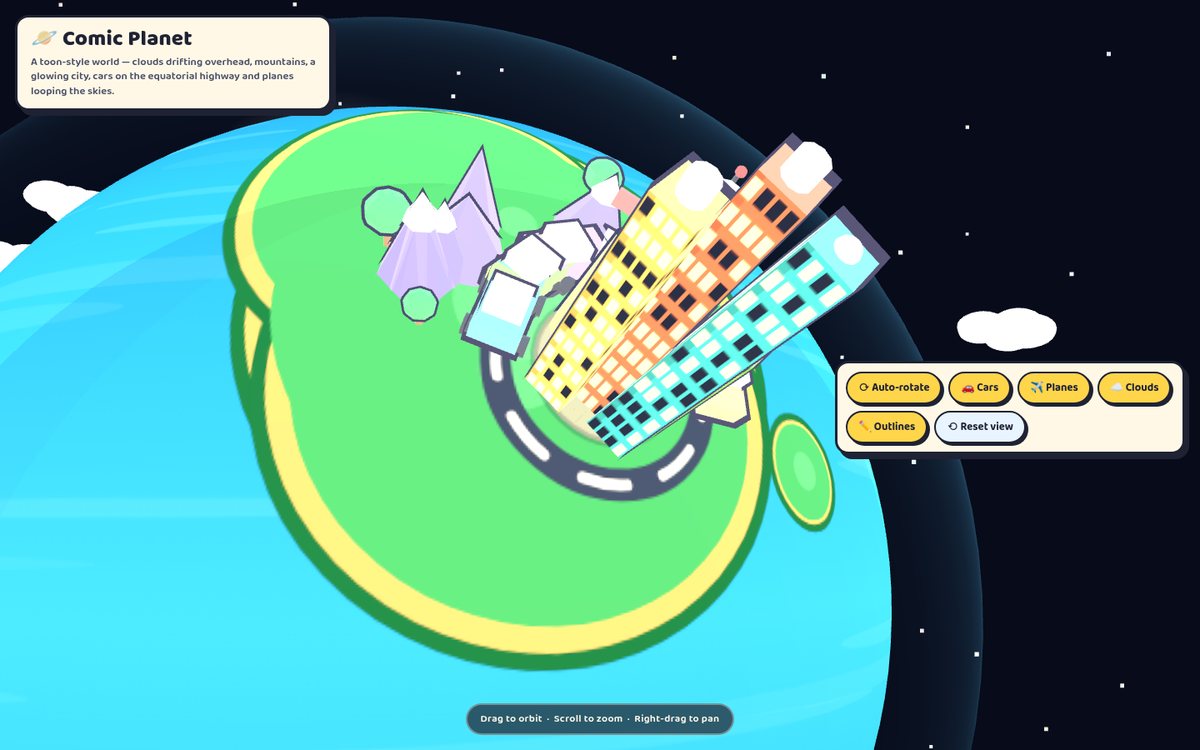
| Inkling 2 Mini | |
|---|---|
| Continents | 4 (2 green, 2 desert) + 8 islands |
| Cities | 1 (ring road around a 6-building CBD) |
| Buildings | 7 (6 city + 1 landmark tower with a flag) |
| Cars | 6 |
| Other life | 4 planes, 11 clouds, 9 mountains, 3 mesas, ~12 trees, a satellite, a moon, a sun and 900 stars |
| Extras | Outline toggle, day-sky gradient, fresnel atmosphere, sun-and-moon orbit |
| Triangles, in the scene | 46.7k |
| Meshes, in the scene | 247 |
I took these screenshots in a software-rendered browser, so I’m not quoting frame rates from it.
Against the local runs
I’m putting this run next to the two Qwen3.8 numbers from my earlier article, same test, same machine. They aren’t a fair race — different serving stacks, different drafters, different context sizes — but they’re the right comparison for scale.
| Inkling 2 Mini (this run) | IQ3_S | IQ3_XXS | |
|---|---|---|---|
| Total time | 25.7 min | 53.5 min | 102.7 min |
| Waiting for the model | 24.9 min | 42.4 min | 75.4 min |
| Running tools | 0.8 min | 11.1 min | 27.4 min |
| Model turns | 166 | 205 | 331 |
| Tool calls | 165 | 203 | 333 |
| Edits to the code | ~36 | 44 | 73 |
| Output tokens | 168k | 155k | 277k |
| Output speed, whole run | about 110 tok/s | about 61 tok/s | about 61 tok/s |
| Times it compacted its history | 1 | 3 | 6 |
| Screenshots it saved of its own work | 37 | 45 | 59 |
| Final page | 5 files, ~676 KB | 56 KB, 1,328 lines | 82 KB, 1,794 lines |
| Console errors when opened | 0 | 0 | 0 |
The cloud runs in the original article took 5.5–14 minutes, though they received project notes and a single index.html line, and ran in different agents. Mine never received either.
What I noticed
- It finished on its own. No second prompt, no step-in, no console errors. Same as the two Qwen runs.
- Most of the run was the model, not the tools. 24.9 minutes of waiting against 0.8 of tool time — even though it was generating at about 110 tok/s. The bill is still the model.
- Half the time, half the effort. 166 turns and 165 tool calls versus 205 and 333 for IQ3_S and IQ3_XXS, fewer edits, fewer screenshots, half the compactions. The whole run was about half the slowest Qwen run.
- It needed very little scaffolding. A folder of five files instead of one file:
index.html,style.css,main.js,three.min.jsandOrbitControls.js, and it opened straight in a browser. - One run is not a race. The Qwen numbers come from Strata; this one from vLLM-redshift. The Qwen runs had a 1 GB VRAM reserve; this one used the whole card. Neither comparison is fair, and neither is a ranking.
What this doesn’t show
- One run. Models vary from run to run, so none of this ranks Inkling 2 Mini against IQ3_S or IQ3_XXS.
- Different servers, different settings. Strata (0.2.9 and 0.2.10, MTP drafter, 128k context, 1 GB reserve) vs vLLM-redshift (v0.5.1, DSpark drafter, 196k context, whole card). Different flags, different speed.
- Not the same test as the cloud runs. No project notes here, and a different agent. Notes could make a local run shorter or longer, and I haven’t tried that.
- No score. There’s no blind judge and no rubric, same as the original article. Which planet is better is a matter of taste, so play them and decide.